Gemini 4 Argon starts a restricted rollout; Runway pilots ads and DeepMind tests protein watermarks
Today's briefing separates access from ambition, alongside Barclays' Claude expansion, a public-interview privacy choice and a practical Mac teleprompter guide.
6 developments2 min brief · 3 min full readSources linked throughout
Partial research for October 1, Europe/Berlin. With no completed prior cutoff, we assumed September 30 at 14:38 CEST to October 1 at 14:38 CEST, plus a partial September 17–October 1 gap scan. Date-only announcements cannot be placed precisely within that window. The September 29 interview study is a labelled catch-up; the getcta guide is a current documentation check. X originals and wider discovery gaps remain; no complete research cutoff advances.
AI Daywire · AI-assisted editorial illustration
Who can use a system now, which actions require approval and what the evidence actually measures are the practical questions across today's releases and research.
Google announces Gemini 4 Argon, starting with restricted cyber-defender access Google announced Gemini 4 Argon on September 30, with access initially rolling out to selected cyber defenders through Fairwind. Its stated one-million-token limit is for output; broader developer and consumer access remains forthcoming. [S1]
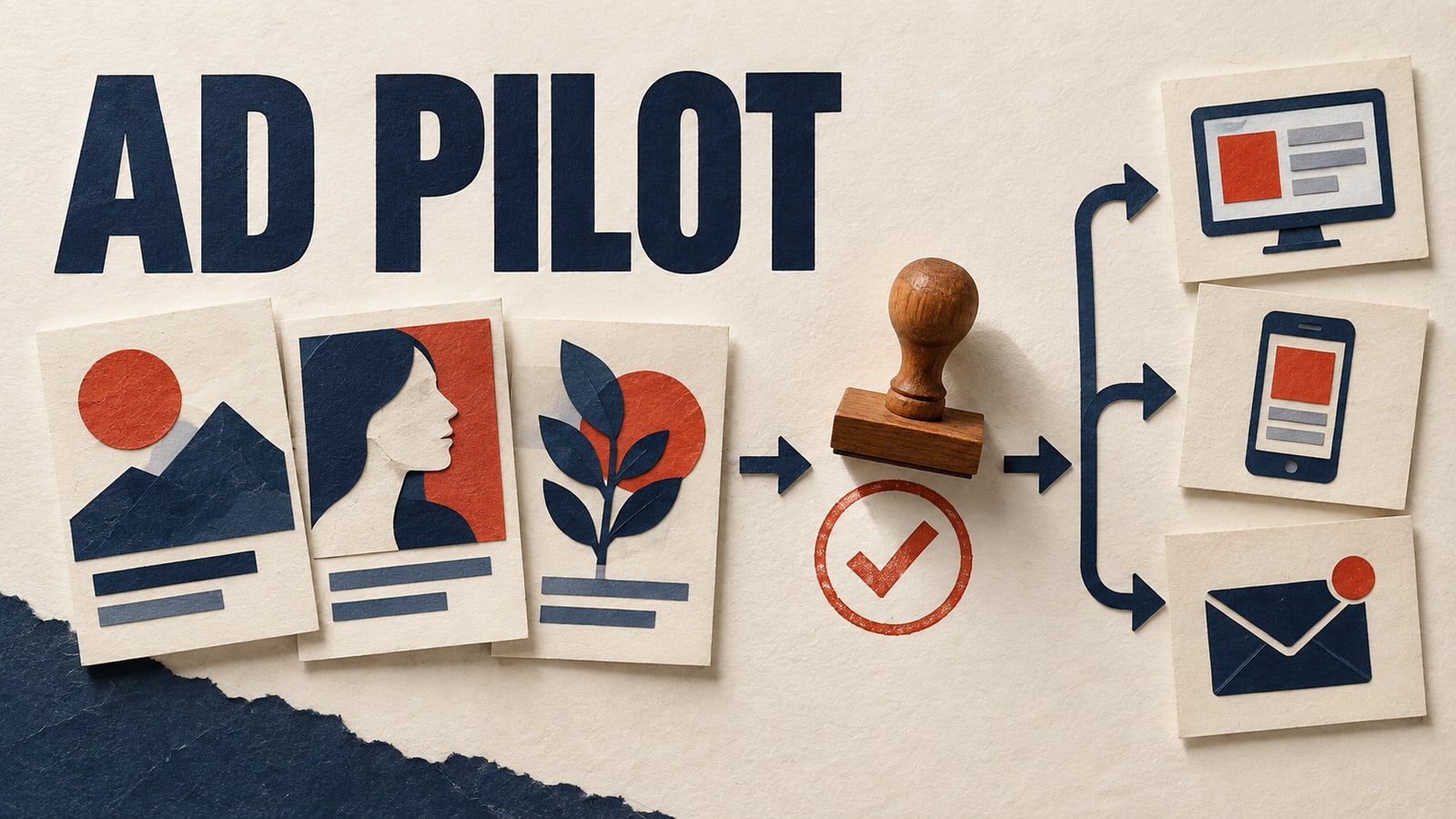
Runway pilots an ad-creation loop with human approval switched on by default Runway announced Runway Ads on September 30: a system for generating creative, publishing approved variants to Meta, Google and TikTok, and using performance data to produce the next batch. Access is an enterprise pilot with selected partners. [S2]
SynthID Bio demonstrates protein watermarks, with real-world screening still a research goal Google DeepMind's September 30 SynthID Bio work, published in Nature, demonstrates watermarks in designed protein sequences and predicted structures. The authors report preserved function in tested binders, while describing practical screening applications as future work. [S3][S4]
Barclays expands Claude use and sets a year-end developer-adoption target Anthropic's October 1 announcement says Barclays is expanding Claude across software development and operations. The bank expects Claude Code adoption to reach half its developer population by the end of 2026; that is a target, not a completed rollout. [S5]
Catch-up: Anthropic's AI interview study makes public transcripts an explicit choice Anthropic's September 29–October 6 study invites eligible Claude users to a roughly 15-minute AI interview. Sharing publicly is optional, but means releasing the full interview and country; the company warns that personal details may identify participants. [S6]
Guide: getcta separates a free Mac prompter from paid voice-follow and AI scripting Documentation-based; not hands-on tested. In an October 1 check, getcta's official site offers a Mac teleprompter download and distinguishes free auto-scroll from the $9-per-month Pro plan's voice-follow, AI tools and 60 monthly AI credits. [S7][S8]
The full briefing
Context & implications
01 / Models & Agents
Google announces Gemini 4 Argon, starting with restricted cyber-defender access
AI Daywire · AI-assisted editorial illustration
news
Event: 30 September 2026announcedcompany claim
Google says Argon supports up to one million output tokens for extended reasoning and work. It plans a wider release beginning with paid API customers and Google AI Ultra subscribers, but gives no firm date. A subscription alone should not be read as confirmation of access today. [S1]
Announced introductory prices are $2 per million input tokens and $10 per million output tokens, rising to $4 and $20 afterward; the introductory period's end is unspecified. These are vendor specifications and rollout plans, not our performance test. [S1]
02 / Creativity & Media
Runway pilots an ad-creation loop with human approval switched on by default
AI Daywire · AI-assisted editorial illustration
news
Event: 30 September 2026announcedcompany claim
The proposed workflow connects an ad account and brand kit, generates image and video variants, checks branding and sends approved ads to supported platforms. Runway says it also localizes assets, reformats them and iterates using returned performance data. [S2]
Human approval starts enabled, although teams can choose automated publishing for particular campaigns or variant types. The announcement invites selected enterprise partners to an early-access pilot; it does not establish general availability or a public price. We have not tested the system or its advertised business outcomes. [S2]
03 / Science & Research
SynthID Bio demonstrates protein watermarks, with real-world screening still a research goal
AI Daywire · AI-assisted editorial illustration
news
Event: 30 September 2026reported
The researchers embed detectable signals into protein sequences and predicted three-dimensional structures. Their experiments found comparable binding performance for watermarked and unwatermarked binders across three tested targets. These are the authors' results, not an independent replication. [S3][S4]
The distinction is provenance: identifying how a design was generated does not by itself establish that it is safe. The paper reports weaknesses under deliberate manipulation and says operational use needs further research, coordination and standards. Its proposed screening and database applications should not be read as protections already deployed. [S4]
04 / Business & Infrastructure
Barclays expands Claude use and sets a year-end developer-adoption target
AI Daywire · AI-assisted editorial illustration
quick update
Event: 1 October 2026announcedcompany claim
The announcement separates existing systems from future adoption. It says the knowledge assistant has handled over one million searches, while a Global Markets platform uses Claude to classify, enrich and route roughly 120,000 emails daily. [S5]
Barclays expects Claude Code to reach 50% of developers by year-end and a majority of software engineers in 2027. The usage figures come from the vendor's account of the partnership. They do not independently establish productivity gains or improved customer outcomes. [S5]
05 / Safety & Society
Catch-up: Anthropic's AI interview study makes public transcripts an explicit choice
AI Daywire · AI-assisted editorial illustration
quick update
Event: 29 September 2026announced
This dated catch-up concerns a study still open on October 1. Anthropic says participants can review their transcript before choosing public release. It excludes account details such as names and email addresses, but does not plan to edit interviews routinely and cannot guarantee anonymity. [S6]
Declining public release still permits research analysis. Removing Anthropic's copy later cannot erase copies others saved. The company also acknowledges that Claude users, and especially those opting to publish, are not a representative sample of the public. [S6]
06 / Tools & Applications
Guide: getcta separates a free Mac prompter from paid voice-follow and AI scripting
AI Daywire · AI-assisted editorial illustration
guide
Guide checked: 1 October 2026company claim
The app places script text beneath the MacBook camera notch. The free tier lists the prompter and auto-scroll; Pro adds speech-following and scripts from notes, Notion, Google Drive or files. This is a current documentation check, not a newly established launch date. [S7][S8]
The maker says speech recognition runs on the Mac and the prompter is hidden from screen sharing and recording. Those are untested product claims; local speech processing should not be assumed to cover every AI feature. Windows and Linux remain listed as forthcoming. [S7][S8]
Source notes
Primary documents, company announcements and research are identified below. A company claim is not an independent test.